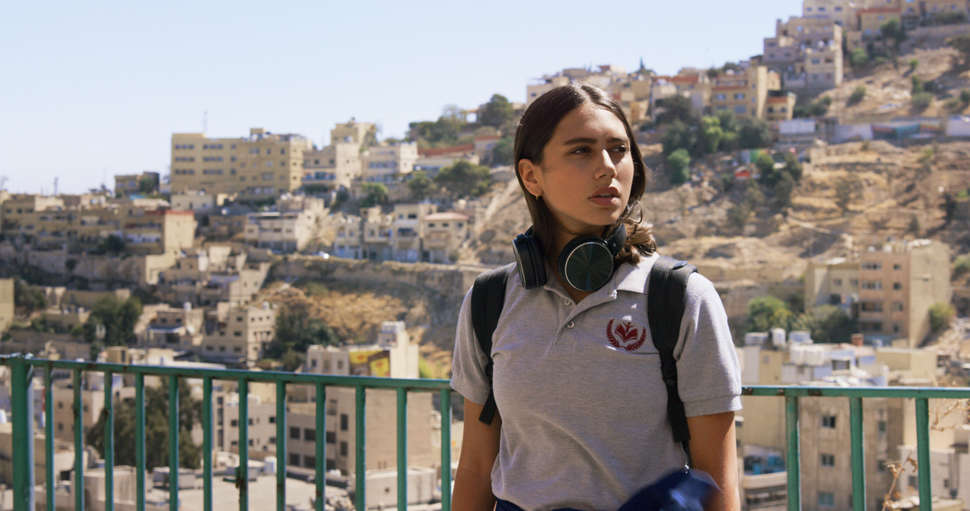
Supernaturally appealing young people and old forces crash in Jinn, the primary Arabic-language arrangement to debut on Netflix. The five-scene appear - made by Mir-Jean Bou Chaaya, Elan Dassani, and Rajeev Dassani - pursues a gathering of Jordanian secondary school understudies whose lives are assailed by the jinn, extraordinary powers, after a school excursion to Petra turns out badly, prompting the baffling lethal fall of one of their schoolmates. It's an enticing reason and Jinn could essentially offer watchers a Middle Eastern turn on the tropes of adolescent powerful shows found in any semblance of Buffy the Vampire Slayer or Teen Wolf. Tragically, Jinn, which feels like it could have occurred anyplace, is so conventional, it appears to be conceivable that it was scripted by calculations instead of people.
The idea of the jinn, otherworldly creatures that are a backbone in both pre-Islamic fables and Islamic folklore, present close boundless topical open doors for a TV appear: the conflict of the cutting edge with old powers; the juxtaposition of pre-Islamic indigenous information and Islamic tenets; the possibility of jinns having bodies as a wide allegory for adolescence (consistently look to Buffy for thoughts!); and the feelings of dread of notable disasters causing issues down the road for contemporary Jordan, first of all. Jinn shockingly decides on a warmed-over variant of Twilight, however in spreading out the standards and cutoff points of its extraordinary universe, is considerably more confounding than the Stephanie Meyer arrangement.
In Jinn, the hero, antisocial cool young lady Mira (Salma Malhas), accidentally brings an other-common defender as the seething Keras (Hamzeh Okab). He supplies her with Edward Cullen-esque axioms about her capacity to spare everybody and trusting in herself. In the mean time, Mira's colleague, the harried and harassed Yassin (Sultan Alkhail), has comparatively pulled in Vera (Aysha Shahaltough), a jinni with loathsome aims. Except if they act promptly, malicious jinn will be released upon the world.
The greatest inquiry concerning Jinn is which crowd it expects to serve. Non-Arab spectators as of now have a not insignificant rundown of extraordinary high schooler dramatizations they can go to for the rash risk of adolescents. The principal scene of Jinn plays out like a Petra travelog for Westerners (albeit a portion of the show's all encompassing shots are shocking), peddling the "fascinating" Middle East while dropping in on our center gathering of teenagers carrying on seriously and implicitly encouraging that nothing will be that not quite the same as other TV youngsters. The Dassani siblings, who pitched the show's idea to Netflix, are Indian-Americans. Elan Dassani stresses that they were driven by a longing to demonstrate that "Middle Easterner youngsters are much the same as teenagers around the globe."
In the event that Jinn is intended for Middle Eastern crowds, it charges more terrible. There are no lead hijabi characters and religious personality is non-existent, which is odd for a demonstrate that handles an otherworldly animal ubiquitous in Islamic writings. More terrible, the show's discoursed are heavy and ungracefully interpreted from the English notwithstanding Lebanese executive Mir-Jean Bou Chaaya's inventive contribution (notwithstanding being a co-maker, he coordinated three of the show's scenes). In an enlightening remark concerning the show's obfuscated social vocabulary, Rajeev Dassani noticed the impact of the show's to a great extent teenager cast: "They're really doing their own interpretations of the exchange," he told Al Arabiya. While "genuineness" is full of inconsistencies, Jinn is shorn of practically any social explicitness that may pervade it with some life. Its variant of Jordan feels as nonexistent as Agrabah.
Similarly that the Mormon subtext in Twilight is covered, indicates set in the Middle East shouldn't have the weight of obviously speaking to topical issues. However on the off chance that Jinn's motivation was to adapt Arab adolescents, it expected to give us access on a various scope of contemporary expectations and goals. Rather, the majority of its characters are figures in administration of its plot once in a while moving out of their one-dimensional American adolescent dramatization tropes. Indeed, even the bum advance father with his tattoo sleeve and extensive liquor utilization is an unmistakable platitude. On the off chance that Jinn was in any event effective in its tropes, the danger of the jinn wresting control of these young people's bodies and supplanting them with a vindictive new character - Invasion of the Body Snatchers style - would be paid attention to additional. Rather, you'll figures that character transplants are actually what a portion of these characters need.
In October a year ago, Netflix discharged Elite, a Spanish TV dramatization that pursues a gathering of favored and poor adolescents at a tip top Spanish private academy. First class has a considerable amount of threadbare, though fulfilling, lathery rushes, however it is additionally amazingly keen in its treatment of Palestinian-inception sibling sister pair, Nadia and Omar, played to extraordinary impact by Mina El Hammani and Omar Ayuso. The show stresses their unmistakable characters, double social battles, and thriving sexuality while never othering their folks as orientalist personifications. It's unusual that a show delivered in Spain could be genuine about the contentions that can emerge among confidence and high school celebration. All things considered, even verisimilitude doesn't make a difference if a show is secure with what it needs to state. Consider Sex Education, another Netflix youngster dramatization from Britain. Moordale High appears to be an entry toward the West, yet the show utilizes its ridiculous school setting to delineate off color and moving exercises about sex and real self-governance.
The sum total of what Jinn has is its 'Middle Easterner youngsters carrying on gravely' curiosity, a difference to the moralistic Arab cleansers Middle-Eastern crowds are utilized to. The show has rounded up debate up Jordan with its delineation of high school sexuality, medication and liquor use, and coarse language. It even pulled in the fury of Amman's open investigator who requested of Jordan's national cybercrimes office to expel the arrangement from Netflix because of its "indecent scenes." Many clients via web-based networking media have comparably censured the arrangement for its bold depiction of sexuality, and the arrangement has been vigorously downvoted on IMDB with a 3.4 rating. In the meantime, numerous in the legislature, including Ali Bin Hussein, the relative of King Abdullah II, have staunchly guarded the show and Netflix's right to speak freely. However this degree of open debate is just a demonstration of Jinn going about as a social indicator of perspectives on profound quality and ladies' sexuality. Its social cachet is obviously unbalanced to whatever occurs on the show.
The show's just essential trade occurs in Episode 3 when Vera portrays a story to Yassin. "Quite a while prior, there was a young lady. She had no companions. She was living in an unjustifiable world and she couldn't fit into such a reality where a few people abused others and misused them for the sake of the law. Also, that was sufficient. She chose it was sufficient." For a concise minute, I was helped to remember the pleasurable political sharpness of folktales. Be that as it may, by Jinn's end, disentangling on a progression of turns, my advantage had disappeared in a puff of smoke.

No comments:
Post a Comment